Nasal strips, sprays and dilators: what is different?
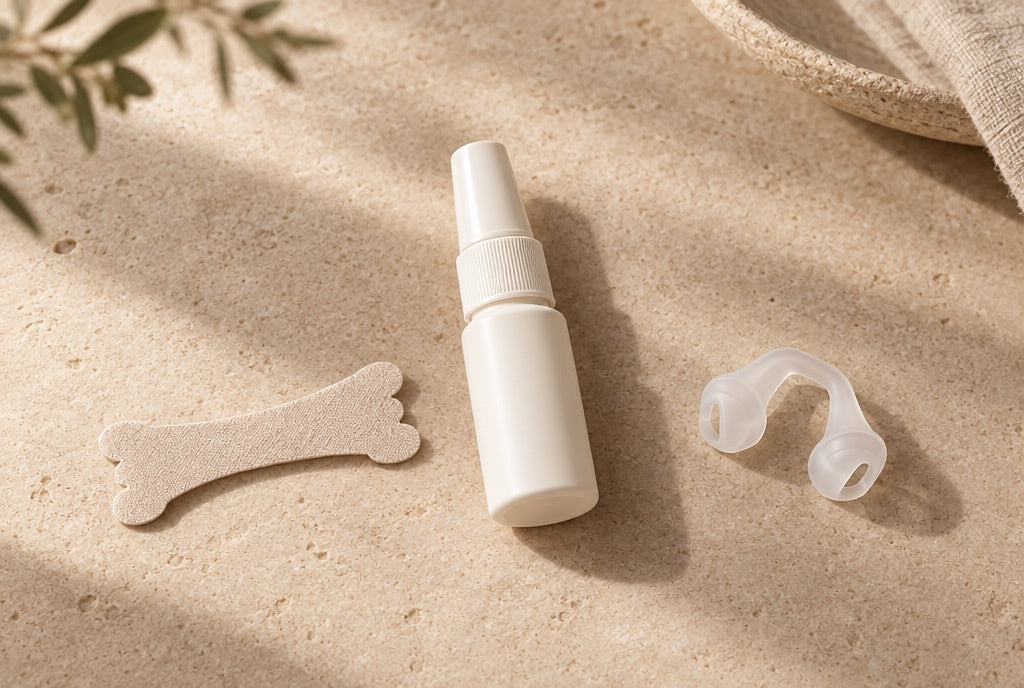
A nasal strip, a spray and an internal dilator may appear in the same search results, but they are not interchangeable products. Some offer mechanical support; others deliver a medicine or saline. Start with the reason your nose feels restricted, then compare each format's intended use and daily routine.
This guide explains the formats and the questions to ask. It is not a diagnosis or a recommendation to replace a treatment you already use.
External nasal strips: support from outside
An external strip adheres across the nose and gently lifts its sides. TONE uses this mechanical approach, with soft woven fabric in Ivory, Honey and Cacao. Nothing goes inside the nostrils, and the strip does not deliver a medicine.
An original external-dilator study linked nasal sidewall support with changes in airflow during maximum inhalation. It tested another product, not TONE; it does not establish that every strip produces the same result. Read the category research.
The practical trade-off is skin contact. Application needs clean, dry skin and removal should be gentle. TONE strips are single-use. If you prefer an external format and a skin-inspired appearance, those features may matter more to your choice than a sweeping comparison claim.
Internal dilators: support inside the nostrils
Internal dilators sit inside the front of the nose. Their shapes, materials and fitting instructions differ, so check the particular device rather than assuming every option works alike. An NHS patient leaflet distinguishes these inserts from adhesive strips worn externally. See the NHS explanation of the formats.
Before choosing one, look for clear sizing information, instructions for insertion and removal, and any cleaning or replacement requirements. Do not assume a product is reusable just because it looks more substantial than a strip. Follow its own instructions.
Preference also matters. Some people want nothing inside the nose; others would rather avoid facial adhesive. That is a format choice, not evidence that one category is universally more effective.
Nasal sprays are not one category of treatment
Read the active ingredient and intended use. A bottle shape tells you little about what is inside.
- Decongestant sprays are medicines for short-term congestion relief. They reduce swelling in nasal blood vessels. Prolonged use can worsen congestion; follow the label and ask a pharmacist about the correct duration. NHS decongestant guidance.
- Steroid sprays act on inflammation. For example, the NHS describes beclometasone nasal spray as a treatment for allergic-rhinitis symptoms. It is not the same product as a decongestant spray. NHS beclometasone information.
- Saline products provide saltwater rather than those medicines. A fine-mist spray and an irrigation device also differ. If using a rinse, follow its cleaning and water-safety directions; ordinary tap water is not appropriate for nasal irrigation. FDA nasal-rinsing guidance.
Do not start, combine or stop medicines based on a brand comparison. A pharmacist or clinician can help you identify the right type for your symptoms and circumstances.
Review TONE's external format and current product details.

Compare the daily routine, too
Once you understand the purpose, compare the practical details: where the product sits, how it is fitted, whether it is single-use, how it is removed or cleaned, and what its current instructions require.
Keep costs comparable. A pouch price, a bottle price and a reusable-device price describe different quantities and routines. TONE's product page shows the current pack price and cost per day based on one fresh strip per day. That calculation should not be used to invent an equivalent dose or replacement schedule for another product.
For TONE's routine, see the application guide. If nighttime use is your main interest, read what to expect from nasal strips for sleep.
Frequently asked questions
Can a strip replace my prescribed nasal spray?
Do not make that substitution without advice. External support and medication address different things. Continue prescribed treatment as directed by your clinician.
Are strips automatically safer because they are external?
No product format removes the need to follow instructions. Adhesive can irritate skin. Stop using TONE if irritation occurs, and ask about suitability if you are unsure.
Which option treats sleep apnea?
Do not use this comparison to select sleep-apnea treatment. TONE does not treat sleep apnea. Diagnosis and treatment belong with a qualified healthcare professional.
Compare TONE's three skin-inspired shades.
Sources
- Di Somma et al. External nasal-dilator research.
- East Sussex Healthcare NHS Trust. Nasal support options.
- NHS. Decongestants.
- NHS. Beclometasone nasal spray.
- FDA. Nasal rinsing safety.
By TONE editorial. Product education, not personal medical advice. Sources describe general information, not clinical testing of TONE. Images are AI-created illustrations.