How to remove nasal strips gently, without rushing
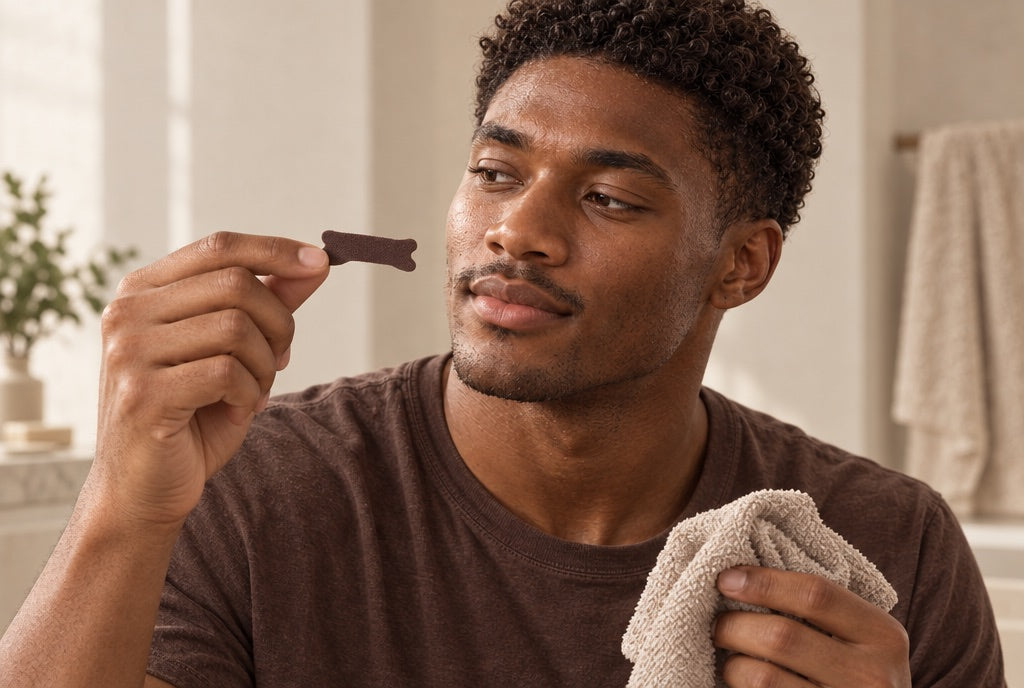
A nasal strip is designed to stay in place while you wear it. Removing it deserves a different approach: warm water, a slow peel and permission to pause. There is no prize for getting it off in one movement.
If you worry about pulling, a sticky feeling afterwards or how your skin might react, it helps to know the removal steps before your first wear. This guide explains TONE's routine clearly without promising that every person's experience will be identical.
Start with warm water
Use comfortably warm water to wet the strip before removing it. You can do this at the sink as part of washing your face. Avoid using water that feels hot, and do not rush directly from dry wear to a quick pull.
Let the water reach the strip and its edges. Rather than setting an arbitrary countdown, pay attention to how the edge releases. If it still feels firmly attached, add more warm water and wait before trying again.
Peel slowly, and pause when you need to
Find an edge and begin easing it away gradually. Move a little at a time instead of pulling the whole strip outward at once. Keep the movement controlled so you can stop if you feel resistance or discomfort.
If the next part does not release easily, pause. Wet that area again before continuing. Do not turn a small moment of resistance into a reason to tug harder. The goal is to remove the adhesive contact thoughtfully, not to test how quickly it can break free.
Once the strip is off, discard it. TONE strips are single use. Washing a removed strip, saving it on its backing or adding another adhesive does not make it ready for another wear.
What if there is residue?
TONE does not make a residue-free guarantee. Different skin preparation, wear conditions and removal habits can produce different experiences. A clean-looking result for one person should not be presented as a promise for everyone.
If you notice a sticky trace, continue with gentle washing using warm water rather than scraping it with your nails or scrubbing the area aggressively. Do not use household solvents to remove facial adhesive. If the area feels irritated, leave it alone and ask a healthcare professional for advice instead of experimenting with several removal products.
Review TONE's strip format and product details.

Give your skin the same care
TONE has an adhesive backing designed for wear on skin. Do not assume it is hypoallergenic, latex-free or suitable for every skin sensitivity. If you have reacted to adhesives before, ask for relevant product information and speak with a healthcare professional before trying another adhesive on your face.
Pay attention to burning, itching, a developing rash or skin that feels sore. The NHS describes these as possible features of contact dermatitis, which can follow contact with an irritant or allergen. Stop using the product rather than applying another strip over the affected area. Read the NHS guide to contact dermatitis symptoms.
Seek medical advice for a severe reaction or worsening symptoms. This article is a product-care guide, not a diagnosis of a mark or rash. A photograph or a product label cannot tell you why your skin is reacting.
Make the next application easier
The next routine begins with skin that is comfortable, clean and fully dry. Do not treat removal and reapplication as one continuous task if the skin needs a break. Follow the instructions supplied with the product and avoid applying to broken or irritated skin.
Preparation also helps you evaluate the product fairly. Applying over skincare, repeatedly repositioning a strip and then removing it dry creates several changing factors at once. A consistent, simple routine makes it easier to notice what feels right for you and what does not.
Plan your supply around single use
Each TONE pouch contains 30 single-use strips, a 30-day supply at one fresh strip per day. If your routine calls for more than one fresh application in a day, allow for that when choosing your pack. Follow the wear directions on your pouch and never reuse a removed strip.
Ivory, Honey and Cacao share the same 66 × 19 mm format. Choosing another shade changes the look, not the removal instructions. Use the same warm-water, slow-peel routine for all three.
Removal questions
Should I pull it off quickly like a plaster?
No. TONE's approach is warm water followed by slow removal. Pause and add water if an edge resists.
Does residue mean I should use a stronger cleaner?
Not automatically. Avoid aggressive scrubbing or household solvents. If gentle washing is not enough or the skin is uncomfortable, seek advice.
Can I reuse a strip if it still feels sticky?
No. It is a single-use product. Remaining stickiness is not a sign that a removed strip is suitable for another wear.
Compare the TONE shades for your next pouch.
For the complete routine, read how to apply nasal strips and the skin-tone nasal strip buying guide.
Sources
By TONE editorial. Product education, not personal medical advice. Sources describe general information, not clinical testing of TONE. Images are AI-created illustrations.